

- Download our Delhi Schools Guide
Most newcomers find transport and driving in Delhi overwhelming at first. Cars, buses, bicycles, motorcycles, auto-rickshaws, e-rickshaws, and pedestrians are all on the same crowded roads.
The Delhi Metro is the quickest way across the city, although the bus network is more extensive. For door-to-door trips, most expats rely on app-based cabs and auto rickshaws. If you're new to the city, it's best to leave the wheel to someone else at first, and many expats hire a private driver for the whole of their stay.
Public transport in Delhi
Metro
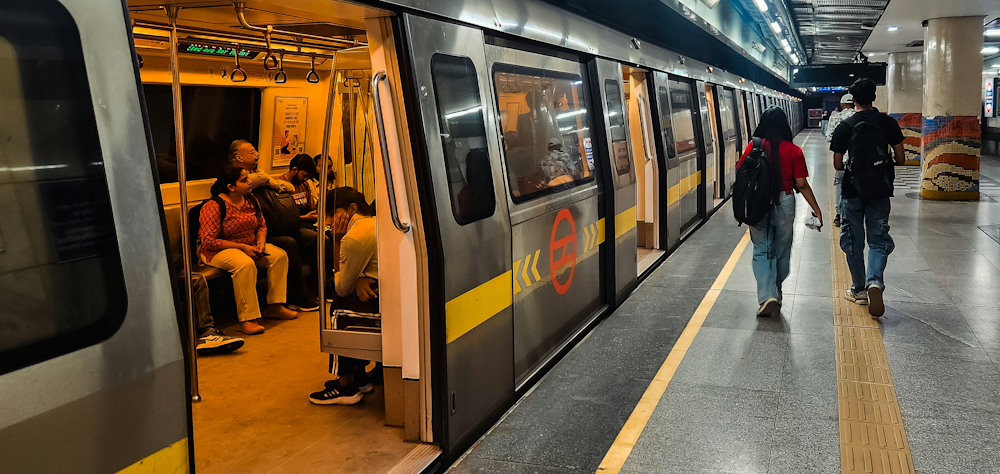
Of all the public transport in Delhi, the metro is the easiest to master. Trains are fast, clean, frequent, and air-conditioned. The network is India's longest and busiest, and there are stations well beyond the city limits in Gurugram (still widely known as Gurgaon), Noida, Ghaziabad, Faridabad, Bahadurgarh, and Ballabhgarh.
New lines and stations are being added. The Pink Line is now a complete loop around the city, and the Airport Express Line is the quickest route between New Delhi Railway Station and Indira Gandhi International Airport.
Fares are distance-based. For one-off journeys, you can buy a QR ticket at the station or on DMRC's official app. Regular commuters are better off with a rechargeable DMRC smart card. Smart card users get a discount on every trip, and the discount is bigger outside peak hours.
DMRC's app also has a multiple-journey QR ticket, which is essentially a smart card on your phone. A National Common Mobility Card (NCMC) from an Indian bank is another option, and you can use it on Delhi's buses too.
You might want to steer clear of the metro at rush hour, when trains on the busiest lines are packed to the doors. The first coach of every train is reserved for women.
Outside many stations, there are e-autos, bike taxis, e-rickshaws, and shared bicycles for the final leg home. DMRC arranges some of these last-mile services itself.
Buses
Delhi has India's largest fleet of electric buses, and the Delhi Transport Corporation (DTC) now runs the entire city network. The Delhi government wants residents out of their cars to ease congestion, and it has invested heavily in new buses as a result.
Most of the fleet is now made up of air-conditioned electric buses, and the newer ones have CCTV cameras, GPS tracking, panic buttons, and wheelchair access. Smaller DEVI (Delhi Electric Vehicle Interconnector) buses are feeder services between residential neighbourhoods and the nearest metro station or main bus route.
Buses are still crowded at peak times, and journeys are slow when the traffic is heavy. They're the cheapest way to get around though, and there are routes to nearly every corner of the city. Tickets are sold on board by conductors, and the official One Delhi app has digital tickets and live bus locations.
Trains
The newest trains in the capital region are the semi-high-speed Namo Bharat services on India's first regional rapid transit line. Meerut is now less than an hour from Sarai Kale Khan in southeast Delhi on this 51-mile (82km) line, and there are stops at Anand Vihar and Ghaziabad on the way.
Sarai Kale Khan station is an interchange with the metro's Pink Line. Hazrat Nizamuddin Railway Station and the Sarai Kale Khan Inter-State Bus Terminal are both a short walk away. For longer trips across India, the main railway stations are New Delhi, Old Delhi, Hazrat Nizamuddin, and Anand Vihar.
Useful links
- Delhi Transport Corporation (DTC)
- Delhi Metro Rail Corporation (DMRC)
- DMRC Smart Card
- National Capital Region Transport Corporation (NCRTC): Namo Bharat
Taxis in Delhi
For trips of more than a few miles, taxis in Delhi are usually your best bet. That's especially true on scorching summer days or during the monsoon, when an open-sided rickshaw is no match for the weather.
Most residents book cabs through apps rather than flag them down on the street. Uber and Rapido are the biggest names, and Ola is still widely used. The government-backed Bharat Taxi cooperative is a newer option. The bigger apps also offer auto rickshaws and bike taxis.
Taxi stands are still common in many markets, although black-and-yellow cabs are far rarer than they once were. If you hail a taxi on the street, make sure the driver turns on the meter. Agree on a fare before you set off if they won't use it.
The Delhi government licenses app-based taxi companies with more than 25 vehicles. Under the licence terms, these companies must install panic buttons linked to the 112 emergency number and switch their fleets to electric vehicles by 2030. You can also share your trip live with a friend through the apps, which is a sensible habit late at night.

Rickshaws
Plenty of residents hop into a rickshaw for short trips around Delhi. On a cycle rickshaw, the driver pedals up front while you relax on a covered bench behind. These are the classic way to get through the narrow lanes of Old Delhi. Motorised traffic is banned from the main Chandni Chowk street during the day, but cycle rickshaws are still allowed. There's usually a queue of them near the Red Fort end. Elsewhere in the city, they're less common than they used to be.
Auto rickshaws are the green-and-yellow three-wheelers on almost every street corner. They're cheaper than taxis, and auto drivers weave through Delhi's notorious traffic with surprising agility. An auto can seat up to three passengers plus the driver.
Battery-powered e-rickshaws are far more common these days, and they're the usual choice for the hop between a metro station and home. Most are shared, and drivers pick up passengers along set routes, although you can also pay to have one to yourself.
The meter is compulsory, but many drivers would rather haggle. Agree on the fare before you get in, or book through an app to lock in the price upfront.
Useful links
Driving in Delhi

Driving in Delhi can be quite the adventure. The city's roads are notoriously chaotic, and many drivers treat traffic rules as loose guidelines. If you're set on getting behind the wheel, be prepared to drive defensively and be alert to the erratic behaviour of other road users. Pedestrians, stray animals, wrong-way motorcyclists, and unexpected obstacles are all part of daily life on the road here.
Indians drive on the left, as in the UK. Conditions are at their worst in thick winter fog and during monsoon downpours, when many underpasses are underwater. On days of severe smog, the authorities can also ban older Bharat Stage III (BS-III) petrol and BS-IV diesel cars under the Graded Response Action Plan (GRAP), so check a car's emissions standard before you buy one.
If you're planning an extended stay in Delhi, your best move might be to hire a driver. It's a common arrangement among middle- and upper-class Indian families as well as expats. A good driver takes the stress out of Delhi's traffic and handles the hunt for parking. Newcomers also find that a driver helps them get to grips with local road habits and the city's layout. If you're here for work, ask your employer whether they'll arrange one, since it's a common perk in expat packages.
Driver's licences
Foreigners can use their home driver's licence in Delhi for up to a year, as long as they also carry an International Driving Permit (IDP) issued in their home country. Expats who stay longer than that need an Indian driver's licence from the Delhi Transport Department.
Holders of a valid foreign licence can apply without a practical driving test, although they usually still have to pass the computer-based learner's licence test on the rules of the road. Licensing officials don't always apply this exemption consistently, so it's wise to bring your original licence, passport, visa, and proof of address to the appointment. Applications and appointment bookings are online through the national Parivahan Sarathi portal.
Useful links
Cycling and walking in Delhi
Expats who keep their wits about them can manage cycling and walking in Delhi, although neither is easy on the busiest roads. There are cycle tracks in parts of North and South Delhi, but drivers of three-wheelers and other vehicles often use these 'dedicated' lanes too, so cyclists are rarely as safe on them as they should be.
Cycling to work isn't practical for most residents because of the traffic and pollution, but leisure rides are another matter. The ceremonial boulevard between Rashtrapati Bhavan and India Gate is a favourite among cyclists and runners. Its official name is now Kartavya Path, although many Delhiites still call it Rajpath. Early mornings are the best time to ride there, when the air is cooler, and the roads are quieter.
If walking is more your style, you'll need to be cautious along busy roads, where pavements are often broken or missing altogether. It's still a fantastic way to soak up local life though. For a quieter stroll, head to Lodhi Garden, Sunder Nursery, Deer Park in Hauz Khas, or Buddha Garden, where the paths are shaded, and the roar of traffic is muffled.
In May and June, afternoons are often hotter than 104°F (40°C), so it's best to walk early or late in the day. Check the air quality index before you head out in November and December, when smog levels are often hazardous.