

- Download our Delhi Schools Guide
Expats who size up the pros and cons of moving to Delhi will find plenty in the city’s favour: a low cost of living, widespread English, a fast-growing economy, and centuries of history to dig into. The main drawbacks are air pollution, safety, cultural differences, and the demands of family life, and you’ll want to think them through before you commit.
Below are the main pros and cons to bear in mind before you move to the Indian capital.
Lifestyle in Delhi

+ PRO: Centuries of history and a busy arts scene
Residents can see the same sights on their doorstep that millions of tourists cross the globe to see, and history is part of the everyday lifestyle in Delhi. Humayun’s Tomb and the Qutub Minar are both UNESCO World Heritage Sites. Traders in Old Delhi still sell spices and silver jewellery from bazaars first laid out in the Mughal era.
Fans of contemporary culture are well served too. There’s a packed programme of talks, film screenings, concerts, and exhibitions at the India Habitat Centre, and collectors fly in from around the world for the annual India Art Fair.
- CON: Food hygiene standards and ‘Delhi belly’
Delhi is famous across India for its food, from the chaat stalls of Chandni Chowk to the kebab joints around Nizamuddin. Hygiene standards are improving, but still patchy, and many newcomers have a bout of the notorious ‘Delhi belly’ in their first few months. The tap water isn’t safe to drink, so most expat homes have a reverse osmosis water purifier in the kitchen.
Busy, well-reviewed restaurants are a safer bet than empty ones, and it’s best to go for street food only when it’s fresh and piping hot and the stall has a queue of locals. It’s also sensible to build up a tolerance for spicy food gradually.
Cost of living in Delhi
+ PRO: Low cost of living
The cost of living in Delhi is low by global standards, and the city is cheaper than Mumbai. Utilities, groceries, transport, and eating out are all a fraction of the price you’d pay in a Western capital. The main exceptions are imported food, wine and spirits, prime rentals in South Delhi, and international school fees.
Domestic staff are another major perk. Many expats employ a cook, a cleaner, a driver, or a nanny, and you’ll have more time for your career and your family as a result.
Cost of Living in Delhi
Domestic Help in Delhi
Health and safety in Delhi
- CON: Pollution is hazardous
Air quality is the biggest health and safety concern in Delhi, and it's considered one of the most polluted cities in the world. Smog is at its worst between late October and January, when crop stubble in Punjab and Haryana is burned and residents set off fireworks for Diwali. Vehicle and industrial fumes are also trapped close to the ground in the cold, still winter air. The air is cleanest during the monsoon, but pollution is above safe levels for most of the year.
Children, pregnant women, older residents, and people with asthma or heart conditions are the most vulnerable. The authorities restrict construction work and the operation of older vehicles under the Graded Response Action Plan (GRAP) when air quality is poor, and schools will sometimes move classes online during the worst spells.
Most expats run air purifiers at home, check the daily air quality index (AQI), wear N95 masks outdoors on bad days, and keep children inside when readings are high. Some families also take a winter break abroad at the height of the pollution season.
+ PRO: Excellent private healthcare
If you do fall ill, you can rest assured that Delhi’s private hospitals are among the best in India. There are large hospital chains such as Apollo, Fortis, Max, and Medanta across Delhi and the wider National Capital Region (NCR), and several of their facilities are accredited by Joint Commission International (JCI). Doctors in private hospitals speak English, and the city is a big hub for medical tourism.
Public hospitals such as the All India Institute of Medical Sciences (AIIMS) have highly respected specialists, but waiting times are long, and wards are crowded. Expats should take out private health insurance before they arrive.
- CON: Crime and harassment, especially for women
Safety is a real concern in Delhi, and the risks are highest for women. India’s National Crime Records Bureau (NCRB) regularly records more crimes against women in Delhi than in any other major Indian city. Petty theft is also common, and phone snatching is a particular problem in crowded markets and on public transport.
Violent crime against expats is relatively rare, but female expats often deal with unwanted attention in crowded places. This can be anything from persistent staring to groping.
Most expats live in gated communities or in neighbourhoods with private security guards. App-based taxis with live trip sharing are a safer choice at night than cabs hailed on the street. The Delhi Metro Rail Corporation (DMRC) reserves the first coach of its trains for women. It’s best not to walk alone late at night in poorly lit areas.
Healthcare in Delhi
Safety in India
Accommodation in Delhi
+ PRO: Spacious, well-equipped homes
Most expats settle on one of two kinds of accommodation in Delhi. Leafy South Delhi neighbourhoods such as Vasant Vihar, Shanti Niketan, Greater Kailash, and Defence Colony are full of spacious ‘builder floors’. These are low-rise blocks with one large apartment on each floor, and the top and ground floors often have private terraces or gardens.
In Gurugram (formerly Gurgaon), gated high-rise communities along Golf Course Road have pools, gyms, round-the-clock security, and backup generators. They’re especially popular with expats who work in Gurugram’s corporate offices.
- CON: Patchy power and water supplies
Power cuts and water shortages are part of life in Delhi in summer, when temperatures often exceed 113°F (45°C) and electricity demand is at its peak. Residents in many neighbourhoods have to buy water from private tankers when the municipal supply is low. Leaks and damp are common in older buildings during the monsoon, and some landlords are slow to fix them.
Before you sign a lease, check that the property has a power backup (a generator or an inverter), a water storage tank, an RO water purifier, and air conditioning in every bedroom.
Accommodation in Delhi
Areas and Suburbs in Delhi
Local culture in Delhi
+ PRO: English is widely spoken
English speakers usually find local culture in Delhi easier to slot into than they expect. Hindi is the language of the street, but English is the working language of business, government, higher education, and private healthcare. Most expats in South Delhi and Gurugram get by in English at work and around town.
Lots of Delhiites switch between the two languages mid-sentence, and locals call the result Hinglish. Expats who learn a few words of Hindi will find it easier to deal with auto-rickshaw drivers, market traders, security guards, and domestic staff.
- CON: Patriarchal society
Delhi is still a patriarchal society, although the younger Delhiites tend to hold more progressive views. Women are underrepresented in the workforce and in senior roles, and sexism is common at work and in everyday life. Expat women sometimes find that shopkeepers, tradespeople, landlords, and even colleagues address their male partner rather than them. Modest dress is sensible in conservative areas such as Old Delhi and at religious sites.
- CON: Local attitudes to personal space
Delhiites are famously warm and hospitable, but their approach to personal space and privacy can be different from what expats used to. Strangers often ask about your job, your salary, your marital status, and why you don’t have children yet. These questions are usually friendly curiosity rather than rudeness.
Foreigners are frequently asked to pose for selfies at monuments, and queues at ticket counters and metro doors can be more of a scrum than an orderly line. A polite but firm ‘no’ is perfectly acceptable.
Getting around in Delhi

+ PRO: Public transport is improving rapidly
Getting around in Delhi is far easier than it used to be, mainly because of the metro. The Delhi Metro is now one of the longest metro networks in the world, and it has lines out to Gurugram, Noida, Ghaziabad, and Faridabad. Trains are clean, air-conditioned, frequent, and inexpensive. The Airport Express Line is the quickest way between the airport and central Delhi, and DMRC has more lines and extensions under construction.
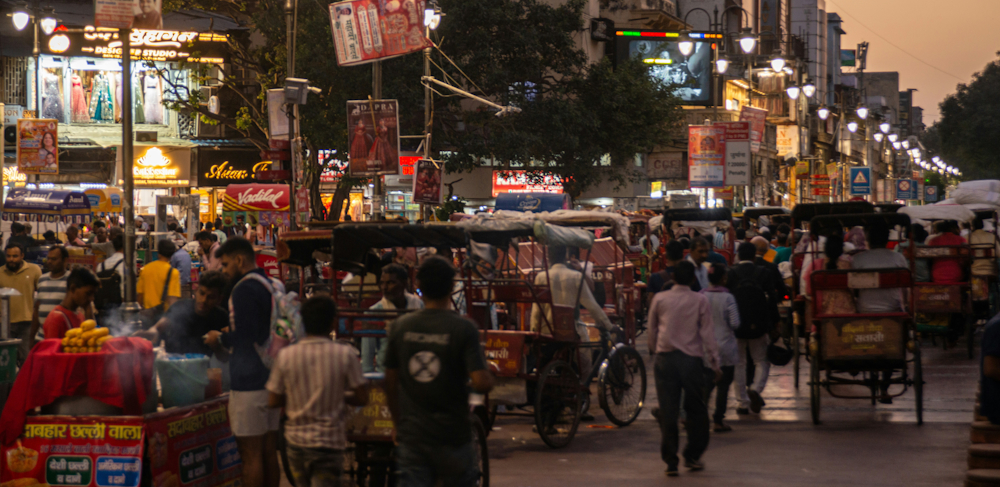
Buses are even cheaper but tend to be crowded. Auto-rickshaws and electric rickshaws are handy for short hops and for the last stretch home from a metro station. Ride-hailing apps such as Uber, Ola, Rapido, and inDrive make it easy to book a car or an auto-rickshaw.
- CON: Traffic is a nightmare, and driving can be dangerous
Delhi’s traffic is notoriously chaotic, and motorists can spend an hour or more on a short trip across town at rush hour. Delhiite driving habits are aggressive, and the honking on the roads makes for a constant din. Drivers also have to contend with cyclists, pedestrians, cows, and vehicles on the wrong side of the road. Waterlogged underpasses are a regular monsoon hazard, and visibility can be dangerously low in winter fog.
Many expats use the metro or hire a driver rather than get behind the wheel themselves.
+ PRO: Easy travel across India and beyond
Delhi is one of the best-connected cities in Asia. Indira Gandhi International Airport is India’s busiest airport, and airlines fly direct from there to cities across Europe, North America, the Middle East, and East Asia. Noida International Airport in Jewar is a second option for residents of Noida and Greater Noida.
Agra and the Taj Mahal are about two hours away by fast train, so weekend escapes are easy. Jaipur and the Himalayan foothills around Rishikesh are close enough for a long weekend.
Kids and family in Delhi
- CON: Delhi isn’t the most family-friendly city
Delhiites dote on children, but daily life with kids and family in Delhi can be hard work. Families tend to stay indoors on the worst smog days in winter, and the summer heat is just as limiting in May and June. Pavements are patchy or missing altogether in many neighbourhoods, so it’s tricky to get around on foot with a pushchair. Most families rely on a driver for school runs and outings due to traffic and safety concerns.
Parks such as Lodhi Garden and Sunder Nursery are pleasant for picnics, and malls have indoor play centres for days when the air is bad.
+ PRO: An excellent choice of international schools
Delhi has some of India’s most respected international schools, and the best known are in the diplomatic enclave of Chanakyapuri. The American Embassy School and The British School are popular with diplomatic and corporate families. There are also French and German schools linked to their countries’ embassies.
Gurugram has a growing number of international schools that teach the International Baccalaureate (IB) or Cambridge curricula. Many of Delhi’s top Indian private schools offer the same programmes alongside the national Central Board of Secondary Education (CBSE) syllabus.
- CON: High fees and long waiting lists
International school fees in Delhi are steep, and they’re far higher than they were a decade ago. On top of tuition, families should budget for one-off admission and development fees, plus transport, meals, uniforms, and exam entries.
Places are limited, and the embassy-linked schools give priority to diplomats’ children. Waiting lists can be long, so families should apply as early as they can – a year before the move is ideal. Expats who relocate with an employer should check whether school fees are included in their package before signing a contract.
Private Schools in Delhi
International Schools in Delhi
Working and doing business in Delhi
- CON: Poor work-life balance
Long hours are the norm for professionals working and doing business in Delhi. India’s legal limit for a standard working week is 48 hours, but many employees are expected to put in more. Six-day weeks are still common at some Indian companies. Office culture is hierarchical, so junior staff are often reluctant to leave before their manager.
Expats at multinationals will regularly have to take late-evening calls with colleagues in Europe or the USA, and many also have to deal with a commute of an hour or more each way. The pace can be exhilarating, but newcomers should be ready for a tougher work-life balance than they’re used to.
+ PRO: A fast-growing economy and strong career prospects
Delhi NCR and Mumbai are India’s two biggest business hubs, and India is one of the fastest-growing major economies in the world. IT, telecommunications, finance, consulting, and e-commerce are the strongest sectors for skilled expats. Gurugram is home to the Indian headquarters of hundreds of multinationals, and Noida is a big centre for IT and electronics manufacturing. New Delhi is the base for government ministries, embassies, international organisations, and NGOs, so there’s steady demand for consultants, lawyers, journalists, and policy specialists.
The Confederation of Indian Industry (CII) and the Federation of Indian Chambers of Commerce and Industry (FICCI) both have their headquarters in New Delhi, and several foreign chambers of commerce run regular networking events in the city. If you’re a skilled professional, the opportunities here can be immense, and Delhi is an excellent place to build a career.